
Restaurant food cost control has never been easy, but in 2026, food costs have become one of the most pressing operational problems restaurant operators face. According to the National Restaurant Association's State of the Industry report, average food costs are now more than 35% above pre-pandemic levels. In 2025, 82% of operators reported higher average food costs and 68% said tariffs drove those increases. Meanwhile, 42% of operators said their businesses were not profitable last year at all.
The USDA projects food-away-from-home prices are going to rise another 3.6% in 2026. Full-service restaurant menu prices are already up 4.3% year-over-year as of March 2026. Restaurant operators are stuck between rising input costs and guests who are increasingly cautious about spending. That gap is not going to close through menu price increases alone.
The operators who hold their margins in this environment are the ones who have tightened their purchasing workflows, not just their menus. Smarter procurement means knowing your true ingredient costs in real time, having access to multiple vendors so you can compare and switch when prices shift, and eliminating the manual work that creates blind spots in your food cost data.
Key Takeaway: Restaurant food cost control in 2026 requires more than watching what you spend. It requires visibility into what you are buying, from whom, at what price, and whether those decisions still make sense given today's supplier landscape. BlueCart gives operators the purchasing infrastructure to make those decisions faster and with better data.
Why Food Cost Control Breaks Down
Most restaurant purchasing workflows have the same structural problem: orders go out by phone or email, and invoices come back in different formats from different vendors. Someone has to manually enter that data into a spreadsheet or accounting system. Prices change from week to week, and pack sizes shift without notice. By the time a manager has calculated actual food cost for the period, the information is already a week old.
According to the Food Institute, 41% of operators say tariffs have increased their ingredient costs, and 25% cite supply chain volatility as a major obstacle. Shopping around for suppliers and negotiating with existing vendors are now among the most common cost-control strategies. But those strategies only work if you have accurate, current pricing data to act on.
The problem is that most restaurants do not have that up-to-date pricing data. When invoice data is entered manually and vendor comparisons require pulling multiple systems or catalogs, purchasing decisions default to habit rather than analysis. You stick with the vendor you know because switching feels harder than it is.
Real-Time Invoice Data Changes the Math
BlueCart's AI-powered invoice OCR uses Claude AI to extract structured data from any invoice format, whether it is a photo taken at the receiving dock, an emailed PDF, or a paper slip. Item names, quantities, pack sizes, and unit prices are captured automatically and organized in the purchasing dashboard without any manual entry.
This matters for food cost control because accurate invoice data is the foundation of everything else. When delivered costs are captured correctly and in real time, operators can track pricing changes from specific vendors over time, catch pack size changes that inflate per-unit cost, and make thorough comparisons between suppliers. The data that used to take hours to compile is already in the system by the time the receiving manager moves on to the next task.
Clean invoice data also feeds into longer-term reporting. Over weeks and months, patterns become visible. Now operators can easily spot the produce vendor whose prices have quietly increased 12% over two months or the meat and seafood supplier who is consistently short on pack size without adjusting the price. These are the kinds of cost leaks that go undetected in a manual workflow and show up months later as unexplained margin compression.
Predictive Ordering Reduces Over-Buying and Waste
BlueCart's predictive ordering works from historical depletion rates, real-time inventory levels, and seasonal trends to automatically suggest what to reorder and in what quantities. Instead of a purchasing manager working from memory or last week's order, the system gives users a suggested order based on actual usage patterns.
For food cost control, this is significant for two reasons, including over- and under-ordering. Over-ordering leads to spoilage, which is a direct loss. Under-ordering leads to emergency purchases from whoever has the product available, and the cost is often at a premium. Predictive ordering reduces both by grounding purchasing decisions in data rather than estimation. The more a restaurant uses BlueCart for ordering, the more accurate those suggestions become over time.

Vendor Flexibility Is Now a Cost-Control Strategy
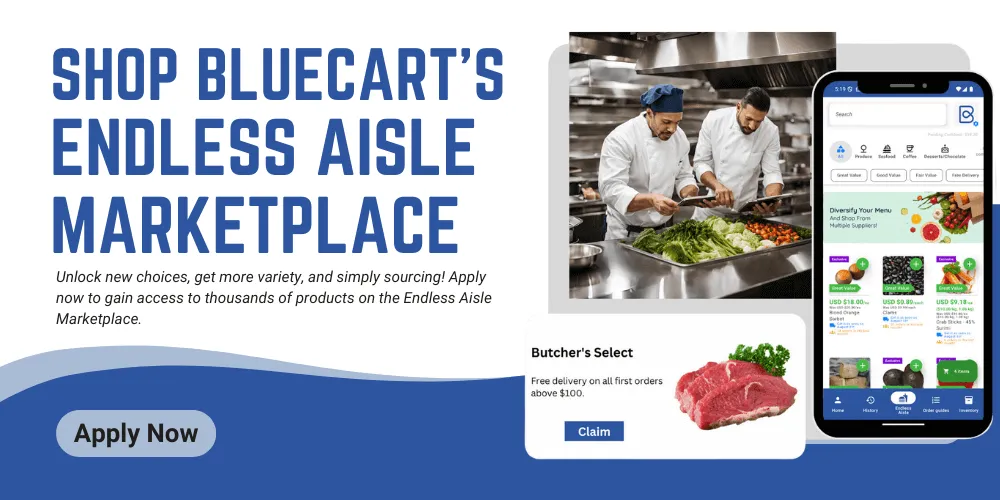
BlueCart's Endless Aisle marketplace connects restaurants with a network of vendors across produce, proteins, dairy, specialty items, and more, all from a single purchasing platform. When a primary supplier raises prices or faces availability issues, buyers can search for alternatives directly within BlueCart without building a new vendor relationship from scratch.
This matters more in 2026 than it did years ago and most restaurant operators have already been shopping around for suppliers as a cost-control strategy. The operators who can do that efficiently, within a single system rather than across phone calls and email threads, move faster and find better pricing more consistently.
Centralizing purchasing also creates a complete order history across all vendors. When you have full visibility into what you have ordered, from whom, and at what price, negotiating with existing vendors becomes more straightforward. Documented volume gives operators a concrete basis for asking for better terms.
Menu Benchmarking Closes the Loop
BlueCart also offers menu costing with industry benchmarking, allowing restaurants to compare the profitability of their own menu items against data from more than 48,000 transacting restaurants on the platform. This gives operators a concrete benchmark for understanding whether their food cost on specific dishes is in line with what similar operations achieve, rather than comparing only against their own historical numbers.
For operators managing food cost under the current pressure, this kind of benchmarking replaces guesswork with a data-backed starting point. Instead of asking whether a food cost percentage feels right, operators can see where they stand relative to the broader market.
See How BlueCart Supports Food Cost Control
If your purchasing workflow still relies on manual invoice entry, email orders, or gut-feel reordering, BlueCart is worth a closer look. The combination of AI invoice processing, predictive ordering, and vendor access through the Endless Aisle, BlueCart is built for operators who need smarter purchasing without a disruptive overhaul.
Book a demo to see how the BlueCart platform can work for your operation.

Frequently Asked Questions About Restaurant Food Cost Control
Operators managing food costs in today's environment ask a lot of the same questions. The answers below help restaurant professionals understand how BlueCart's platform addresses each challenge directly.
What is a good food cost percentage for a restaurant in 2026?
Most full-service restaurants target food cost percentages between 28% and 35%, though this varies by cuisine type, service model, and ingredient mix. The more important number is not where you land against an industry average, but whether your actual food cost aligns with your theoretical food cost based on recipe standards and current ingredient prices. A growing gap between those two numbers is a signal that something in the purchasing or preparation process needs attention.
How does invoice OCR help with food cost control?
BlueCart's AI-powered invoice OCR captures delivered item names, quantities, pack sizes, and unit prices automatically from any invoice format. When that data is imported into your dashboard in real time rather than being entered manually days later, operators can track pricing changes from vendors immediately, catch pack size discrepancies, and make accurate food cost calculations without waiting for a data entry process to catch up.
What does predictive ordering do for food cost?
Predictive ordering reduces over-buying and emergency purchasing, which are two of the most common sources of food cost inflation. BlueCart’s predictive ordering feature suggests orders based on actual usage history, real-time inventory levels, and seasonal patterns. This helps operators order the right amount at the right time, rather than defaulting to habit or estimation.
How does Endless Aisle help when supplier prices rise?
BlueCart’s Endless Aisle gives users access to a network of vendors within BlueCart. When a primary supplier raises prices or faces availability issues, buyers can search for alternatives and place orders without building a new vendor relationship outside the platform. This keeps the entire purchasing workflow in one place and makes vendor switching fast enough to actually act on pricing changes when they happen.
Can BlueCart help restaurants that use multiple suppliers?
Yes, BlueCart is built specifically for restaurants managing relationships with multiple vendors. All orders, invoices, and purchasing history across every supplier live in a single dashboard, so operators have a complete picture of spend without pulling data from separate portals or systems.